Curator’s Statement
When I was invited to curate a show, I was not interested in doing an exhibit that was heavy on theory or a theme that was weighted in the milieu of the current art debate. I instead wanted to do a show that was casual and fit the laid-back approach to curating. I decided that the works would curate themselves. Thus the idea and concept of the title, “Nothing Heavy” came about.
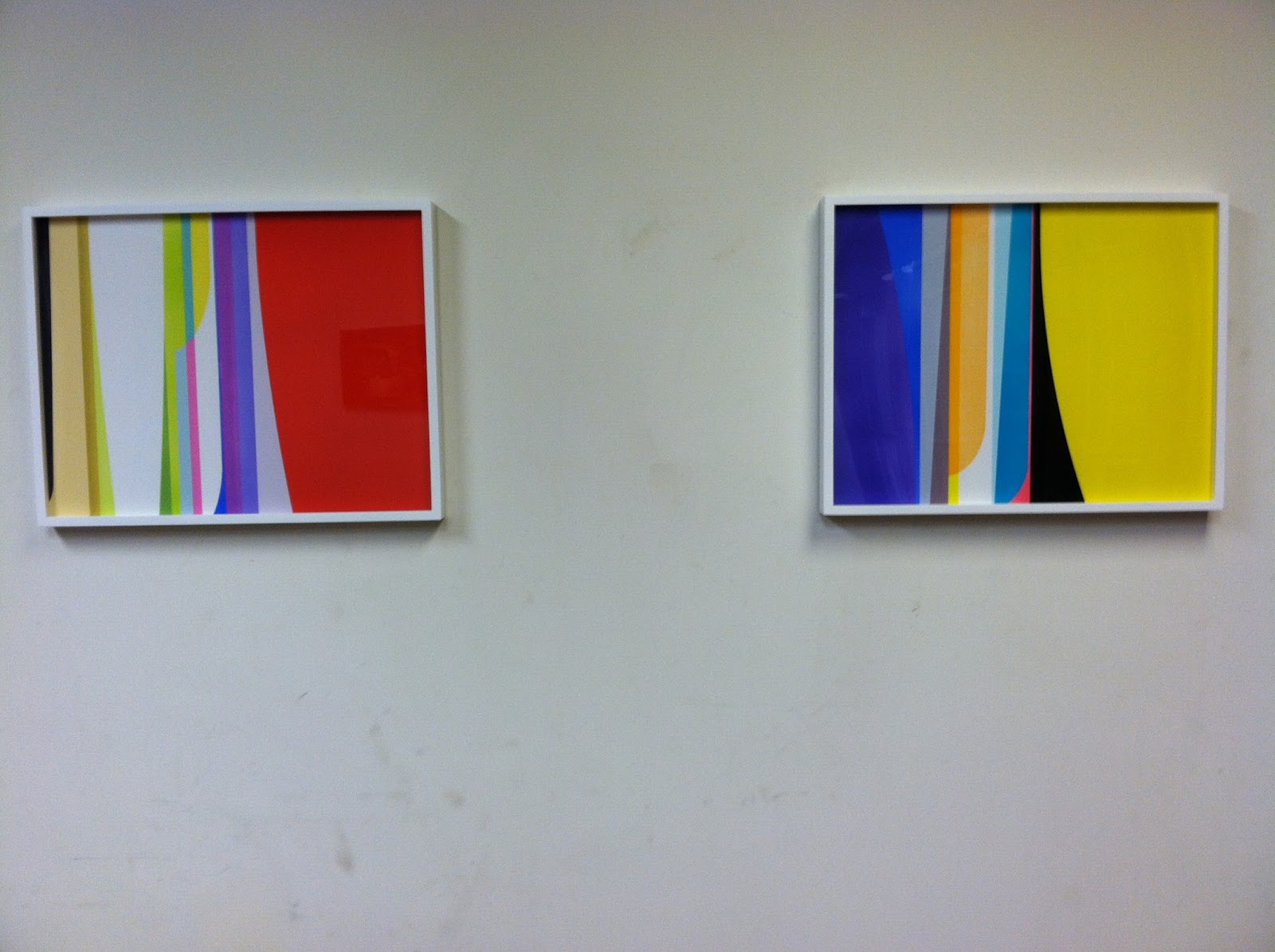
As I began to do visit studios and choose the art, the title became a theme, and the art began to define the show. The title has a double meaning. Taken at its literal, “Nothing Heavy,” means the absence of weight; lightness or the absence of excess. The other meaning can describe casualness or the lifting of a burden. The artists of this show explore both the weight and lightness of various ideas and emotions. From the weight of nature and aggression (Andrew K. Thompson and Tamarind Rossetti), the emotional and physical states of being (Liz Nurenberg and Lisa Talbot), form and color (Jocelyn Grau and Dion Johnson), to memory and spirituality (Christy Roberts, Atilio Pernisco and Kim Zsebe); all represent the exploration of weight upon both the artist and contemporary society. Some works may overlap and transgress into each other themes. In the end, each of the artists and their work explore the idea and concept of weight and the weightless.
Each person has weight that burdens us each day. That weight comes in many forms and expressions. The artists in this show explore how each of those burdens affects their practice, and through their work help release the weight, and thus nothing heavy remains.
In additional to the art and art work, I chose some literary works that explore the same ideas of weight and the weightless. Works by Virginia Wolfe, Christina Rossetti, and Vitruvius, explore the natural, emotional and the physical idea of weight and weightlessness.
In conclusion, I would like to thank LGT, especially Jackie Bell Johnson and Takeshi Kanemura, and the artists who put their faith in me; Andrew K. Thompson, Liz Nurnberg, Lisa Talbot, Tamarind Rossetti, Kim Zsebe, Dion Johnson, Christy Roberts, and Jocelyn Grau. You will all be in heart. Finally to my family and friends, without you my life would be nothing. Thank you
Mario D. Vasquez
Curator
 |
| Installation View (Install Day) |
9. In the case of Archimedes,
although he made many wonderful discoveries of diverse kinds, yet of them all,
the following, which I shall relate, seems to have been the result of a
boundless ingenuity. Hiero, after gaining the royal power in Syracuse, resolved,
as a consequence of his successful exploits, to place in a certain temple a
golden crown which he had vowed to the immortal gods. He contracted for its
making at a fixed price, and weighed out a precise amount of gold to the
contractor. At the appointed time the latter delivered to the king's
satisfaction an exquisitely finished piece of handiwork, and it appeared that
in[254] weight the crown corresponded precisely to what the gold had weighed.
10. But afterwards a charge was
made that gold had been abstracted and an equivalent weight of silver had been
added in the manufacture of the crown. Hiero, thinking it an outrage that he
had been tricked, and yet not knowing how to detect the theft, requested
Archimedes to consider the matter. The latter, while the case was still on his
mind, happened to go to the bath, and on getting into a tub observed that the
more his body sank into it the more water ran out over the tub. As this pointed
out the way to explain the case in question, without a moment's delay, and
transported with joy, he jumped out of the tub and rushed home naked, crying
with a loud voice that he had found what he was seeking; for as he ran he
shouted repeatedly in Greek, "Ευρηκα, ευρηκα."
11. Taking this as the beginning
of his discovery, it is said that he made two masses of the same weight as the
crown, one of gold and the other of silver. After making them, he filled a
large vessel with water to the very brim, and dropped the mass of silver into
it. As much water ran out as was equal in bulk to that of the silver sunk in
the vessel. Then, taking out the mass, he poured back the lost quantity of
water, using a pint measure, until it was level with the brim as it had been
before. Thus he found the weight of silver corresponding to a definite quantity
of water.
12. After this experiment, he
likewise dropped the mass of gold into the full vessel and, on taking it out
and measuring as before, found that not so much water was lost, but a smaller
quantity: namely, as much less as a mass of gold lacks in bulk compared to a
mass of silver of the same weight. Finally, filling the vessel again and
dropping the crown itself into the same quantity of water, he found that more
water ran over for the crown than for the mass of gold of the same weight.
Hence, reasoning from the fact that more water was lost in the case of the
crown than in that of the mass, he detected the mixing of silver with the gold,
and made the theft of the contractor perfectly clear.
Book IX
Ten Books on Architecture
By: Vitruvius
 |
| Jocelyn Grau |
 |
| Installation: Jocelyn Grau |
 |
| Jocelyn Grau |
 |
| Jocelyn Grau |
 |
| Jocelyn Grau |
 |
| Andrew K. Thompson |
 |
| Andrew K. Thompson |
 |
| Andrew K. Thompson |
 |
| Andrew K. Thompson |
 |
| Andrew K. Thompson |
 |
| Andrew K. Thompson |
 |
| Andrew K. Thompson |
Clouds
By Christina Rossetti
White sheep, white sheep,
On a blue hill,
When the wind stops,
You all stand still.
When the wind blows,
You walk away slow.
White sheep, white sheep,
Where do you go?
 |
| Kim Zsebe |
 |
| Kim Zsebe |
 |
| Kim Zsebe |
 |
| Dion Johnson |
 |
| Dion Johnson |
 |
| Installation: Dion Johnson |
 |
| Lisa Talbot |
 |
| Lisa Talbot |
 |
| Lisa Talbot |
 |
| Liz Nurenberg |
 |
| Liz Nurenberg |
 |
| Tamarind Rossetti |
.jpg) |
| Tamarind Rossetti |
 |
| Atilio Pernisco |
 |
| Installation: Atilio Pernisco |
 |
| Atilio Pernisco |
 |
| Atilio Pernisco |
 |
| Atilio Pernisco |
 |
Atilio Pernisco
 |
| Atilio Pernisco |
|
The scene
beneath me withered. It was like the eclipse when the sun went out and left the
earth, flourishing in full summer foliage, withered, brittle, false. Also I saw
on a winding road in a dust dance the groups we had made, how they came
together, how they ate together, how they met in this room or that. I saw my
own indefatigable busyness — how I had rushed from one to the other, fetched
and carried, travelled and returned, joined this group and that, here kissed,
here withdrawn; always kept hard at it by some extraordinary purpose, with my
nose to the ground like a dog on the scent; with an occasional toss of the
head, an occasional cry of amazement, despair and then back again with my nose
to the scent. What a litter — what a confusion; with here birth, here death;
succulence and sweetness; effort and anguish; and myself always running hither
and thither. Now it was done with. I had no more appetites to glut; no more
stings in me with which to poison people; no more sharp teeth and clutching
hands or desire to feel the pear and the grape and the sun beating down from
the orchard wall.
‘The woods
had vanished; the earth was a waste of shadow. No sound broke the silence of
the wintry landscape. No cock crowed; no smoke rose; no train moved. A man without
a self, I said. A heavy body leaning on a gate. A dead man. With dispassionate
despair, with entire disillusionment, I surveyed the dust dance; my life, my
friends’ lives, and those fabulous presences, men with brooms, women writing,
the willow tree by the river — clouds and phantoms made of dust too, of dust
that changed, as clouds lose and gain and take gold or red and lose their
summits and billow this way and that, mutable, vain. I, carrying a notebook,
making phrases, had recorded mere changes; a shadow. I had been sedulous to
take note of shadows. How can I proceed now, I said, without a self, weightless
and visionless, through a world weightless, without illusion?
‘The
heaviness of my despondency thrust open the gate I leant on and pushed me, an elderly
man, a heavy man with grey hair, through the colourless field, the empty field.
No more to hear echoes, no more to see phantoms, to conjure up no opposition,
but to walk always unshadowed, making no impress upon the dead earth. If even
there had been sheep munching, pushing one foot after another, or a bird, or a
man driving a spade into the earth, had there been a bramble to trip me, or a
ditch, damp with soaked leaves, into which to fall — but no, the melancholy
path led along the level, to more wintriness and pallor and the equal and
uninteresting view of the same landscape.
‘How then
does light return to the world after the eclipse of the sun? Miraculously.
Frailly. In thin stripes. It hangs like a glass cage. It is a hoop to be
fractured by a tiny jar. There is a spark there. Next moment a flush of dun.
Then a vapour as if earth were breathing in and out, once, twice, for the first
time. Then under the dullness someone walks with a green light. Then off twists
a white wraith. The woods throb blue and green, and gradually the fields drink
in red, gold, brown. Suddenly a river snatches a blue light. The earth absorbs
colour like a sponge slowly drinking water. It puts on weight; rounds itself;
hangs pendent; settles and swings beneath our feet.
An Except from “The
Waves” by Virginia Woolf (1931)
 |
| Performance by Christy Roberts: "Atonement" 2013 |
 |
| Christy Roberts: "Atonement" 2013 |
 |
| "The Exploding Feathered Inevitable | Punk Rock Pillow Fight" by Andrew K. Thompson |




.jpg)


